February 2026

Welding Safety & Compliance for Small & Mid-Size Shops

Welding safety is essential for small and mid-size manufacturers. From PPE like welding helmets, welding gloves, and respirators to advanced PAPR systems, compliance ensures worker health and productivity. This guide covers low-fume solutions such as low-manganese filler metals, Linde’s proprietary MIG Mix Gold Shielding gas, and safety controls like welding curtains, and at-source capture MIG guns. Explore how PROSTAR Welding Apparel, abrasives, and automation tools like PushCorp by Walter help you reduce exposure, improve weld quality, and meet CCOHS and CSA standards.


Quick Answers to Common Questions

1: Why is welding fume control important?
Based on CCOHS’ recommendation, on gun extraction and LEV reduce weld fume exposure significantly—highlighting the importance of control measures.
CSA standard W117.2:19 (R2023) Safety in welding, cutting, and allied processes. addresses respiratory hazards like manganese and hexavalent chromium in welding fumes, reinforcing this is a key industry concern.

2: Do I need a PAPR if I have ventilation?
CCOHS recommends LEV, on gun extraction, and PAPR, showing PAPRs can offer superior breathing zone protection, validating this as a technical decision trade-offs question.

3: Are low manganese filler metals worth it?
ESAB and Hobart explain the metallurgical and exposure-control benefits of low-manganese filler metals in industrial welding.

4: What standards apply in Canada?
CSA standard W117.2:19 (R2023) Safety in welding, cutting, and allied processes, guidance are frequently cited in relation to welding safety, showing technical relevance across regions.

5: Can at source capture MIG guns replace large ventilation systems?
Suppliers like ABICOR and Bernard detail design features for high-flow fume capture at the gun, indicating technical evaluation of source control solutions.

6: What role does automation play in safety?
3M/Lincoln whitepaper describes robotic weld grinding and safety benefits, targeting shop-floor decision-makers considering automation to reduce exposure.

The SMB friendly safety stack (mapped to the welding workflow)
Goal: Follow the hierarchy of controls—substitution → engineering → admin → PPE—to reduce exposure at each step of the weld cell.


1: Before the arc: choose safer inputs

  • Low manganese filler metals: Lower Mn content helps reduce a key neurotoxic exposure driver in the fume mix. Pair with good process control; still verify with air monitoring.
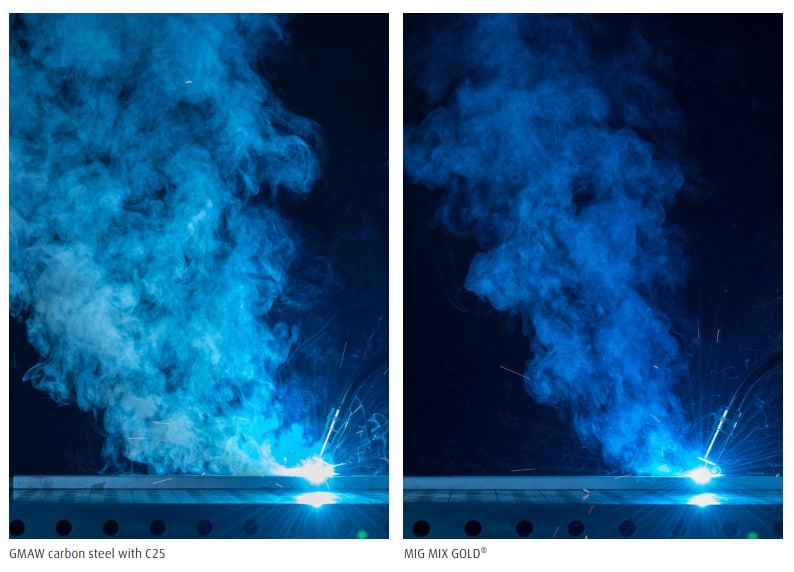
  • MIG Mix Gold (shielding gas blend): Optimize the gas for stable arc, low spatter, and consistent puddle control, helping reduce rework and post weld abrasion needs. (mixture specifics vary; implement per WPS and qualify.)
  • Welding chemicals (e.g., Whale Spray): Use purpose built anti spatter/cleaners to minimize grinding and airborne fine particulates downstream; ensure SDS alignment and proper ventilation.

2: At the arc: remove fumes where they form

  • At source capture MIG guns: Integrated extraction captures a high percentage of fume directly at the nozzle without compromising shielding gas when properly configured; boosts welder mobility vs. fixed arms.
  • Independent studies show on torch extraction reduces nanoparticle exposure in the welder’s breathing zone during arc welding.

3: Around the arc: contain and protect

  • Welding screens, custom screens & curtains: Control line of sight light/radiation, define safe zones, and help manage bystander exposure while supporting airflow design per CSA guidance.
  • Abrasives (pre/post weld): Choose high efficiency abrasives that cut faster and cooler to minimize airborne dust load and time at risk. Pair with downdraft or on tool extraction where feasible (see automation below).

4: Respiratory & personal protection (when needed and as a layer of defense)

  • PAPR welding helmets:
    • Provide clean, filtered air and increased comfort during welding and grinding tasks.
    • Different models offer varying levels of protection — choose systems tested and validated by the manufacturer and ensure they’re used under a compliant safety program.
  • PROSTAR PPE:

Download Technical Resources